Showing posts with label facebook.com/softsheild. Show all posts

Monday, 1 September 2014

GTA V for PC May Be Cancelled


Grand Theft Auto V might not make it to PC after all as according to a certain Brad – Rockstar North employee and founder of marketing firm Rantic – the company is planning to cancel the PC version of the game.
According to Brad, who claims to be a marketing director for Rockstar North, during a recent discussion Rantic Chairman John Hoffberger stated that the PC version of the game could soon be cancelled owing to ‘corporate problems. The interview excerpts popped up on Rantic’s site[currently down because of a hack].
Hoffberger said that the company was never willing to go for a PC version of the game but had to build it anyway to meet with high consumer demand. However, the project will soon be culled.
“The next-gen console launch dates are still intact, but the PC game launch has been agitating for Rockstar staff,” John said.
It seems that Rockstar has apparently delayed the launch of GTA V for PS4, Xbox One and PC till 2015. However, if we are to believe Brad’s claims, then we might never see a PC version 

Saturday, 9 August 2014

LG L60 With 4.3-Inch Display and Android 4.4 Listed on Company's Site


A few days after launching its LG G3 A, the Korean handset maker has listed the new budget L60 smartphone on its Russia website. The smartphone has been listed with specifications but with no availability and pricing details as of yet.
As per the listing, the LG L60 X145 is a dual-SIM device and is powered by the comparatively new Android 4.4.2 KitKat. It is powered by a dual-core processor (unspecified) clocked at 1.3GHz, coupled with 512MB of RAM.
LG's budget offering features a 4.3-inch WVGA (480x854 pixels) TFT display with a pixel density of 217ppi. It also sports a 5-megapixel rear camera with LED flash alongside a 0.3-megapixel front-facing camera. The LG L60 includes 4GB of inbuilt storage, which is further expandable via microSD card (up to 32GB).
The L60 packs a 1540mAh battery rated to deliver up to 5.2 hours of talk time and 264 hours of standby time. It also comes with GPRS/ EDGE, 3G, Wi-Fi 802.11 b/g/n, Bluetooth 4.0, GPS and Micro-USB connectivity options. The LG L60 smartphone measures 66.3x124.15x11.8mm, weighs 119 grams and comes in Black and White colour variants. The listing was first reported by Fonearena.


It is worth noting that other variants of the LG L60 were also spotted earlier this month on Wi-Fi Alliance website (via My LG). The variants spotted were LG-X132, LG-X145, LG-X135, LG-X137, LG-X130j, and LG-X147. It is assumed that all of the variants are the same model but with different model numbers according to the region and the network carriers.
An anticipated handset from LG is the G3 Stylus, a stylus-bearing phablet device that was recently spotted in a LG G3 Beat promo video. Reports hint the smartphone will arrive in Q3 this year, and with mid-tier specifications that won't see it compete with the Galaxy Note 4.

Monday, 4 August 2014

Samsung Galaxy Note 4 to be launched on September 3: Report

Samsung Electronics will unveil the Galaxy Note 4 in Berlin on September 3, the Korea Times said. Samsung hopes the Galaxy Note 4 will counter Apple's new iPhone 6 which is also due for launch in September.
"Samsung will hold an event in Berlin to announce the Note 4 on September 3," a company executive was quoted as saying.
If rumours are to be believed, the upcoming Galaxy Note 4 will come with an ultraviolet sensor to measure UV radiation and consequently alert users about possible precautions they should take.

The Galaxy Note 4 is expected to come with a screen size bigger than the Galaxy S5 and could sport a 2K resolution display. The Galaxy Note 4 is speculated to come engineered with an octa-core Exynos CPU or a Snapdragon 800-series SoC, 4GB of RAM, and a 20.1 megapixel camera with optical image stabilisation.
The South Korean company hopes that the Note 4 will help it get a fresh momentum to lift its handset business at a time when the company is being threatened by the rise of Chinese budget handset manufacturers.

Wednesday, 30 July 2014

TouchPico is an 80-inch Android Touchscreen That Fits in Your Pocket


Our weekly series on crowdfunding projects tries to look through Kickstarter, Indiegogo and other sites to find the most innovative and useful projects you can back. That's because some of the coolest new tech these days, like the Pebble Smartwatch and the Oculus Rift VR headset, didn't come from big companies but rather, from Kickstarter.

This week, we took a look at the TouchPico Indiegogo - this Android-powered projector can turn any surface into a touchscreen, and it hit its funding of $55,000 within 24 hours of the project being launched on Saturday.

The TouchPico is a pocket-sized projector - according to the project page, it's the same size as aSamsung Galaxy S4, and slightly heavier. The projector will use Android 4.2, and will support microSD cards. It can be used to project an 80-inch image - but the really interesting thing is that with the special stylus, you can use that display like a touchscreen.

The stylus - which is pretty big, and looks a little like Pencil, by FiftyThree - uses infrared detection technology to track the stylus. The stylus has a small IR emitter built into it, which is tracked by the projector, to accurately calculate the point where you are touching the screen.
Aside from that, the TouchPico works like any Android device - the page suggests you think of it as a giant Android tablet. You can download apps from Google Play, project a Skype chat on the wall, or use it to display a presentation. It could also be used for gaming, though games that require multiple touch inputs, or use the tilt function, will naturally not be usable. Gestures like pinch to zoom in webpages will also naturally not work.

Despite these limitations, it is easy to see a lot of different scenarios where the TouchPico would be really useful. Watching movies, simple games like Angry Birds or even more complicated games where a single touch input is all that's required, such as Rebuild come to mind, and of course, it would be very useful for presentations. For more examples, check out the video below:


The crowdfunding campaign will close on August 26, and shipping is scheduled to start around 15-30 October. The early bird price is $329 for a projector, with an additional $30 for international shipping.


Saturday, 19 July 2014

Google Glass takes wicked road show to Boston July 26


There are only a few places in the world where you can try out Google Glass in person without having to plunk down $1500 to own one first — and on July 26th one of those places will be Boston, Massachusetts. The Google Glass road show is hitting up Boston later this month, camping out at the The Cyclorama at the Boston Center for the Arts for one day.
If you'll be in the area and want to try out Glass for yourself, hit up the source link below to RSVP. They'll be open from 10AM to 6PM, and will have "local treats and beverages" on hand to satiate your hunger and thirst. No word on if that means wicked clam chowdah.
Source: Google

Saturday, 5 July 2014

iPhone 6 to Launch on September 25, 5.5-Inch Model Named iPhone Air: Report


Another day and another iPhone 6 rumour. This time a report out of China details an astonishing new launch date for the next iPhone from Apple, ahead of most dates in previous leaks. The report is accompanied with purported pricing details, as well as the name of the anticipated larger 5.5-inch iPhone 6 variant - iPhone Air.
The report citing industry sources claims Apple will unveil the iPhone 6 on September 15, which falls on a Monday, while retail availability will begin on September 25, which falls on a Thursday.
Apple traditionally starts sales of new iPhone models on a Friday to capture the weekend crowd, so the dates seem a little fishy. Previous leaks (including a purported internal communication from a German telecom carrier) had indicated a more credible launch date of September 19, which happens to be Friday.
According to the China.com report (via GforGames), China will also be amongst the first countries to receive the iPhone. The report also details the pricing, which matches previous leaks, claiming the 4.7-inch iPhone 6 (32GB) will cost CNY 5,288 (roughly Rs. 50,800), while the 5.5-inch iPhone 6 (16GB) will be priced at CNY 5,998 (roughly Rs. 57,600). This would also imply the 4.7-inch iPhone 6 (32GB) is cheaper than the current 4-inch iPhone 5s (16GB), which costs CNY 5,300.
The same report claims the much-rumoured 5.5-inch iPhone 6 variant will be called the iPhone Air, following the naming scheme of the latest, largest iPad. The report adds that China Mobile and China Unicom, Apple's carriers in the country, have begun field testing the iPhone 6 on their networks.

Recently, Japanese daily Nikkei had posted two alleged images of the rumoured 4.7-inch iPhone 6 dummy model, side by side with an iPhone 5s. The leaked images corroborate what's has been widely expected based on earlier leaks, that the next iPhone will house the power button on the right panel of the device, instead on the top panel seen on current iPhone models. It also seen to feature the Touch ID sensor.

Previously, another Chinese report indicated the alleged 5.5-inch iPhone 6 variant will feature a 128GB storage variant. The report further claims that the 128GB storage variant will be limited to the bigger variant of the rumoured iPhone 6, and the alleged 4.7-inch iPhone 6 will offer the conventional 64GB as its maximum storage variant, while the 16GB variant will be dumped for both models.

An earlier report citing a research note from analyst Ming-Chi Kuo also suggested that the alleged 5.5-inch iPhone 6 would sport OIS (optical image stabilisation) for the rear camera. The report further claimed that the alleged 4.7-inch iPhone 6 will not come with OIS.

The Cupertino-based company has also been rumoured to be testing a higher screen resolution of 960x1704 pixels on at least one of the two iPhone models likely to debut this year.

Thursday, 3 July 2014

Google buys music service Songza to take on Apple and Beats


Google announced today that it's acquiring the streaming-music service Songza for an undisclosed sum. Over the coming months it will be integrating the company's smart playlist creation into Google Play Music and perhaps YouTube. Songza will remain an active and independent app for the time being. The purchase highlights the increasingly competitive landscape emerging around music, as Apple, Amazon, and Google all seek to differentiate their mobile products by offering top-notch streaming services.
When Beats Music launched in January of this year, it offered users the ability to build a playlist based on variables like their mood, location, and activity. Songza actually offered this kind of contextual playlist creation way back in 2010, when it was still web-only. The company launched its mobile app in 2011 and has since grown to serve 5.5 million active users. Sources familiar with the deal say that the purchase price for Songza, which had raised a total of just $6.7 million to date, was far less than what Apple paid for Beats. Earlier reports on the acquisition from the New York Post said Google was offering around $15 million, while The New York Times claims the deal is worth over $39 million.
Google's music service already included a radio feature that generated a playlist based on a user's taste and a song or album they selected as the starting point. It also has a very complex and computer-driven approach to figuring out what music to recommend, one that relies on dual-sided machine-learning technology and advanced machine listening to analyze not just people's taste but the component parts of the songs themselves. Songza, by contrast, offers up simple hand-picked mixes like "Indie Music That's Not Too Weird" and "Easy, Breezy, Summer Songs" that are created by real people and geared to match a person's mood.
In that sense, Songza is closer to Pandora, which uses human musicologists to decide what songs go well together. Beats Music also has a team of editors hired from places like Pitchfork and XXL to create playlists for its users, and even Google's machine learning gets a little help from an in-house record store geek. Across the board, what's valuable is removing the effort of deciding what's next when there are tens of millions of songs to choose from. "Every jukebox in the sky needs curation to be valuable," says David Pakman, a tech investor and former digital music entrepreneur. "Google is admitting humans have a big role to play in that process."
Of course, knowing Google, and what it's trying to do with Google Now, down the road there could be other interesting uses for all the data Songza captures.

Wednesday, 2 July 2014

Facebook Faces Government Probe Over Study That Manipulated Users' Emotions Without Telling Them


Facebook faces a government investigation in Europe over its study of whether manipulating people's news feeds could change their emoti Reportedly recently,Facebook's experiment tweaked the algorithms of nearly 700,000 unwitting users, causing people to see an abnormally low number of either positive or negative posts. People who saw more negative posts wrote more negative posts, and vice versa, showing that their mood was being affected by the kinds of things they were reading on Facebook.
Now, governments in the U.K. and Ireland look set to investigate, according to the Financial Times:
The Information Commissioner's Office said it was probing the experiment and planned to ask Facebook questions after widespread outrage when it was revealed at the weekend. The regulator said it would also be in contact with the Irish data protection body, because Facebook has its European headquarters in Dublin.
A spokesperson for the ICO said it was too early to tell exactly what part of the law Facebook may have infringed. The regulator looks at how much personal data are used and whether users have given their consent.
Facebook won't be helped by the fact that the company didn't alter its terms of service to disclose to users that their posts would be used for research until four months after the experiment took place, according to Forbes:
Four months after this study happened, in May 2012, Facebook made changes to its data use policy, and that's when it introduced this line about how it might use your information: "For internal operations, including troubleshooting, data analysis, testing, research and service improvement." Facebook helpfully posted a "red-line" version of the new policy, contrasting it with the prior version from September 2011 - which did not mention anything about user information being used in "research."
Facebook CEO Mark Zuckerberg need not lie awake stressing over the outcome of any probe, however. The ICO only has the power to levy a fine of up to £500,000 ($857,000), the FT says - which is pocket change in terms of the $3 billion that the social network holds on its balance sheet.

Chumby's smart alarm clock relaunches with 1,000 apps


Remember Chumby? You probably haven't heard much about the snuggly tiny computer/smart alarm clock since its makers' company disbanded, but now it's back from its semi-retired state. Its current owner, Blue Octy LLC, just announced that it's relaunching Chumby's full service (it went offline in 2013), which comes with 1,000 apps and faster, more efficient performance. The device, for those who haven't heard of it before, first launched in mid-2000s, way before everyone has a smartphone to take the place of many other gadgets, and was meant as a high-tech alternative to the bedside clock radio. It's one of those things people used to call "internet-connected devices" and could display Facebook, Twitter and RSS feeds, even video streams.
Unfortunately, the device needs to connect to the Chumby network to function. So, when its original creator (Chumby Industries Inc.) went out of business last year, Blue Octy launched a limited service that lets owners use the device as an alarm clock and a music player, at least. This development gives them the power to make the gadget more useful, though it obviously won't be free. It'll cost $3 per month to restore Chumby to its former glory -- after all, the company needs money to keep the service running.

Facebook Home developer team disbanded

Facebook has disbanded its Home (Android Launcher) team, but the app still lives. 

Facebook's plan to take over the smartphone has not panned out and the social networking site has disbanded its team that was initially responsible for developing Facebook Home. The Android skin released last year displayed Facebook photos on its lock screen and provided easy access to chat messages and status updates.

The Home app released last year wasn't a success that Facebook had hoped for. Although it did a good job of transforming an Android phone into one that felt purpose-built for Facebook, not many users took it up. The skin came preinstalled on the HTC first, but did not get a good response and disappeared shortly after its launch.

Facebook Home saw half a million downloads after its launch, but the growth stalled from there. Google Play lists that the skin has been installed between 1 million and 5 million times which is quiet low for Facebook. Facebook says that it still has a team working on Home, but chances of it moving forward are less. The app remains available in the Play Store, however it hasn't been updated since January.

Facebook has been working on new apps like Slingshot and Facebook Paper. Paper is a magazine-style news reader service and was launched in February. The service is very similar to Flipboard and Google Currents and pulls out relevant content including photos, videos and links from Facebook feed.
Facebook launched a Snapchat clone called Slingshot earlier this month. The app allows users to share videos and photos with their friends, but the only way recipients will be able to see the messages will be if they share something back on Slingshot. The app has been officially launched for Android and iOS platforms.


Monday, 16 June 2014

Samsung Galaxy S5 Prime Tipped to Feature Ultra-Slim Bezels in Leaked Image


Samsung's much-rumoured Galaxy F smartphone, also known as Galaxy S5 Prime, has once again been leaked in an image, this time alongside a Galaxy S5 handset and showcasing a thinner bezel that similar to those on the recently announced LG G3.

The alleged image showing the rumoured Samsung Galaxy F, courtesy Phonearena, not only highlights the smartphone's LG G3-like thin side bezels, but also the slightly slimmer bezels on top and bottom also as compared to the Galaxy S5 , giving more room to the screen while maintaining a smaller profile.
A couple of days ago it was noted that the rumoured prime-variant of the Galaxy S5 might feature the Exynos 5433 SoC and Intel XMM7260 modem, like indicated in previous reports.

Earlier this week, the alleged Samsung Galaxy F's black colour variant was again teased in an image showcasing the brushed metal back panel. Other than that, the alleged premium Galaxy S5 variant will also have an aluminium chassis instead of the chrome plastic frame, as from an earlier report.

Some of the rumoured specifications of the handset include a 5.3-inch QHD (1440x2560 pixel) screen, a Qualcomm Snapdragon 805 processor, and 3GB of RAM. It is also reported to be a limited edition smartphone, due to the expensive nature of its Super AMOLED QHD display.

The Galaxy S5 Prime is expected to launch sometime in September alongside the iPhone 6. Samsung, with its to-be-announced Galaxy F smartphone could finally step away from its plastic image with the anticipated metal rear panels. For now, the firm has its metal Galaxy J smartphone out but that is only available in their home turf and has not been made available globally.

Sunday, 15 June 2014

Alleged iPhone 6 Compared With Samsung Galaxy S5 in Leaked Image


Apple's much-anticipated next iPhone, expected to be called the iPhone 6, has been speculated about and leaked in images several times over the past few months. And it seems there's no stopping till the date Apple officially reveals its next-generation iPhone devices - leaks have been tipping there will be two display size variants - 4.7- or 5.5-inch.
After being compared with the Apple iPhone 5 on Thursday, a new leaked image posted byGSMArena shows the alleged iPhone 6 pictured beside the Samsung Galaxy S5.
The alleged wider, thinner iPhone 6 seems to feature a 4.7-inch display, and is slightly shorter than the Galaxy S5 (which sports a 5.1-inch display) in side by side comparison. The alleged iPhone 6 in the leaked image also appears to be thinner than the Galaxy S5 , which is 8.1mm thick.
Apple's rumoured iPhone 6 is widely anticipated to sport curved edges, doing away with its currentstraight-edge design. Further, the next iPhones' sides are said to house the power button positioned on the right panel of the device, instead on the top panel seen on current iPhone models. Meanwhile, the side panels are likely to include a slightly modified volume buttons.
A Taiwanese celebrity named Jimmy Lin on Thursday posted an image of the alleged iPhone 6 compared alongside iPhone 5 and also shared his first-hand experience with the unannounced iPhone. According to Lin, the alleged iPhone 6 with 4.7-inch display had a great display and was easy to grip despite of its large display size.
A recent report claimed that Apple's next iPhone would hit the shelves on September 19.
The Cupertino-based company has been rumoured to be testing a higher screen resolution on at least one of the two iPhone models likely to debut this year. An earlier report suggested that one of the two alleged iPhone 6 models would come with a 960x1704 pixels resolution screen, compared to the 640x1136 pixels resolution found on the current iPhone models that sport 4-inch displays.
We remind readers however, that nothing is official yet, and that all such leaks must be taken with a pinch of salt.

Thursday, 12 June 2014

Facebook updates iOS and Android apps with Nearby Friends invites and offline likes


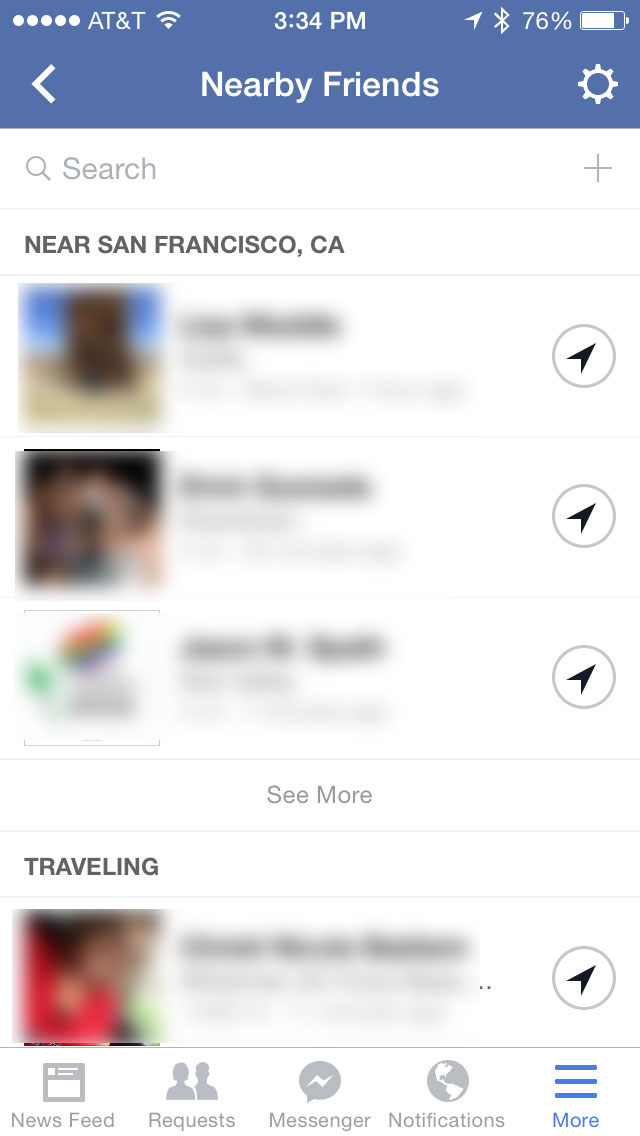
Fcebook has two updates on the mobile world today. Facebook for iOS 11.0 got new additions to its Nearby Friends  feature while Android hit version 10.0 with offline posting. Both updates are available now in the Google Play Store and App Store.
0611 nearby1 220x390 Facebook updates iOS and Android apps with Nearby Friends invites and offline likesFor the iOS version Facebook only posted that today’s update included “improvements for reliability and speed.” But TechCrunch reportsthat after a bit of digging, it found two new updates for Nearby Friends. In the US version of the app, the social network has added search and invite friends buttons.
For Android, Facebook has added the following new features:
  • Like posts, photos and Pages when you’re offline
  • Remove tags you’ve created
  • Remove tags of yourself that your friends have created
  • Turn post notifications on and off
  • Improvements to speed and reliability
Being able to remove tags that your friends have created is a wonderful way to make sure some of the more embarrassing things you did last night don’t end up in your Timeline.
➤ Facebook for iOS and Android

Wednesday, 11 June 2014

Ubisoft debuted some of the best-looking games of E3 2014 – here are the 5 most exciting ones


Ubisoft is on a roll. Between Assassin’s Creed, Far Cry and now Watch Dogs, Ubisofthas a stable of some of the most popular franchises on the market, and the company didn’t disappoint with another huge showing at E3 this year. There weren’t many surprises, but unlike some of the other conferences, many of the games Ubisoft presented will actually be on store shelves at some point this year. This isn’t an outline of the new generation — these are games we’ll all be playing in just a few months.
With just 9 games featured at the live event, it wasn’t hard to pick the five trailers that stood out: Far Cry 4, Assassin’s Creed Unity, The Division, The Crew and Rainbox Six Siege. Of course, both Just Dance 2015 and Just Dance Now (the game’s mobile companion app) should be well-received additions to a very popular franchise. Shape Up also looks like a fresh take on the fitness game genre, and Valiant Hearts: The Great War might have been the most sincere game of the day.
Check out our top five trailers from Ubisoft’s press event below.
Far Cry 4 trailer

Be sure to check out the first official gameplay footage of Far Cry 4 from Sony’s press conference while you’re at it.
Assassin’s Creed Unity trailer

The Division trailer

The Crew trailer

Rainbow Six Siege trailer


SMS and Chat Have Killed Letter Writing, Claims Email's Inventor


Letter writing may have dwindled substantially over the years but billions of people are participating in the written word in the electronic form as never before, says the inventor of email V A Shiva Ayyadurai.
"Email has explosively supported the growth of letter writing globally. Today, unlike some decades ago, where penning letters was limited to a few who could afford education, billions are now writing letters, in electronic form, as never before - albeit, we can argue about the quality of writing - but regardless, more people, than ever before, are participating in the written word," the 50-year-old MIT systems scientist, technologist, entrepreneur and educator told PTI.
In 1978, Ayyadurai invented the world's first email system at the age of 14 and was awarded the first US copyright for "email".
He feels people tend to confuse email with the simple exchange of short text messages such as in texting, SMS, chat or Twitter, saying these have "destroyed" letter writing.
"Email is not the simple exchange of text messages. Email is the electronic version of the interoffice mail system used for formal letter or memo communication," he says.
"Clearly texting, SMS and chat are very different than writing a letter or email. In fact, I believe what is going on is that people are realising that you use short messaging, like texting, SMS, chat, Twitter, etc. for quick informal messages, and you use email for more intimate and formal letter writing.
"In this sense, mail is the preferred medium for 'letter writing', and if anything, texting and chat, are killing 'letter writing'. Email did precisely what I predicted, back in 1978, it took over the postal mail process and system of writing letters."
Mumbai-born Ayyadurai has just come out with a book "The Email Revolution: Unleashing the Power to Connect", published by Allworth Press, in which he demonstrates how organisations can realise the infinite potential of email to strengthen their brands and reach their audiences in incredibly creative ways.
According to the author, email was designed for formal business communication, and as long as we participate in business, email will be here. When he created the first email, he saw its real value.
"The system as a service which could automate all paper-based activities of managing mail in the office environment, by providing features of inbox, outbox, folders, address book, attachments, sorting, archiving, etc. to emulate electronically the interoffice mail system - the email we all use today" says Ayyadurai he realised that email, if adopted widely, beyond its value economically and productivity-wise, would also have immense social implications.
"This is why I also had stated then that email would change our 'patterns of communication, attitudes, and styles'.
Today, email has become a legal medium, for example, and in business communications, especially, people should be more cognisant of what they put in email communications, for it is far different than informal communications such as texting, chat or SMS," he says.
Ayyadurai, however, regrets that the postal service of the US, in 1997 did not heed his advice and embrace email, to become a provider of an email service such as Gmail or Hotmail.
"Such a decision would have positioned them for the future as well as other postal services worldwide, since at that time, most of the world's postal services, looked to the US Postal Service for new innovations," he says.

Ayyadurai, who managed email for the Clinton administration and created email-sorting software which was used by companies like Nike, AT&T and Toyota, gets upset with "so-called experts" who, since the 1990s have been saying that "email is dead".
"When chat came in the early 1990s they said 'Email is Dead'; when SMS came, they said 'Email is Dead'; and when Facebook came, Zuckerberg declared 'Email is Dead'. They all confused short messaging and community messaging with formal messaging. Email is not texting. Email is not a Facebook post," he asserts.
Ayyadurai stresses that email is here to stay.
"I am confident because I know what email is, and what it is not, having invented it. And, more importantly, as a media researcher, and as a systems biologist, I believe that we as humans are hardwired to seek and engage in three different types of messaging modes: Short Messaging, Community Messaging, [and] Formal Messaging," he says.

Ayyadurai believes another smart kid can definitely create another more convenient mode of communication.
"I think there are a bunch of kids out there, given, the right ecosystem, they will create things, we've never dreamed before or thought were 'impossible' - think about a device for telepathic communication - for example - far better than typing away all day," he hopes.

Cell Phones Kept in Trouser Pockets May Affect Male Virility: Study


Do you have a habit of keeping your cell phone in your trouser pocket? It could damage your chances of becoming a father.
According to a study, radio-frequency electromagnetic radiation (RF-EMR) emitted by mobile phones can have a detrimental effect on male virility.
Given the enormous scale of mobile phone use around the world, the potential role of this environmental exposure needs to be clarified.
"This study strongly suggests that being exposed to radio-frequency electromagnetic radiation from carrying mobiles in trouser pockets negatively affects sperm quality," cautioned Fiona Mathews, a professor of biosciences at University of Exeter in Britain.
"This could be particularly important for men already on the borderline of infertility, and further research is required to determine the full clinical implications for the general population," he said.
Most of the global adult population own mobile phones, and around 14 percent of couples in high and middle income countries have difficulty in conceiving.
To reach this conclusion, a team led by Mathews conducted a systematic review of the findings from 10 studies, including 1,492 sperm samples.
The sperm quality was measured in three different ways: motility, viability and concentration. In control groups, 50-85 percent of sperm have normal movement.
The researchers found this proportion fell by an average of 8 percentage points when there was exposure to mobile phones. Similar effects were seen for sperm viability.
The effects on sperm concentration were less clear. The results were consistent across in-vitro studies conducted under controlled conditions, said the study published in the journal Environment International.

Samsung Galaxy S III Neo With Android 4.4 KitKat Listed on Company's Site


Samsung has listed the Android 4.4 KitKat-based Galaxy S III Neo with model number GT-I9301I on its German website without price and availability.
The Galaxy S III Neo (GT-I9301I) is different from the Galaxy S3 Neo (GT-I9300I) launched in Indiaearlier this year at Rs. 26,200, featuring single-SIM support, and a slightly faster quad-core SoC (1.4GHz instead of the Galaxy S3 Neo's 1.2GHz quad-core SoC) instead.
Back in January, Samsung had also launched the Galaxy S III Neo+ smartphone for the Chinese market.
Notably, Samsung Galaxy S III Neo is a 'lite' variant of the company's 2012 flagship smartphone, theGalaxy S III. The smartphone looks similar in design to the Galaxy S III; however, the specifications are different.
The Samsung Galaxy S III Neo (GT-I9301I) features a 4.8-inch HD (720x1280 pixels) Super AMOLED display. The Galaxy S III Neo comes with 1.5GB of RAM and supports expandable storage up to 64GB, while featuring built-in storage of 16GB. It sports an 8-megapixel rear camera accompanied by an LED flash and features CMOS sensor, while there is a 1.9-megapixel front-camera also onboard.
Connectivity options on the Galaxy S III Neo include Wi-Fi, Bluetooth, GPS/ A-GPS, Micro-USB and 3G. The smartphone measures 136.6x70.7x8.6mm and weighs about 132 grams. The Galaxy S III Neo packs a 2100mAh battery.

Nokia Showcases Two-Fold, Three-Fold Flexible 5.9-Inch OLED Displays


Nokia seems to be progressing with the idea of foldable displays, as it demoed two such OLED displays last week in an exhibition at San Diego.
Nokia Corp, along with Semiconductor Energy Laboratory or SEL, gave a glimpse of what the firm holds for future as it displayed two 5.9-inch foldable OLED screens during the Society of Display Information or SID's exhibition.
The Nikkei Technology report notes that while one of the two screens is a two-fold display, the other one is a three-fold display. Both flexible screens come with 720p HD resolution and 249ppi pixel density.
It is worth noting that Nokia and SEL used the "WTC" structure to make these foldable displays. The WTC (white tandem+top emission+colour filter) structure combines white light omitting OLEDs and colour filter. The display is said to be created by fusing two different sets of layers. The first set includes the release layer, sealing layer and colour filter layer on a glass substrate, while the other set includes a release layer, sealing later, TFT layer and an OLED layer on another glass substrate.
Then, the colour filter layer and the OLED layer are attached and the glass substrates are replaced by flexible substrates. This brings the colour filter, OLED and TFT layer fixed together between the sealing layer and the flexible substrate. It has been further reported that the book-type two-fold and the three-fold displays can bend up to 2mm and 4mm curvature radii respectively. It has been added that these displays can be bent more than 100,000 times.
We first saw such flexible OLED displays, dubbed as Youm displays, at the CES 2013 event by Samsung. The firm is yet to make such display screens available in its devices. Samsung however came out with a curved display handset, Galaxy Round as a Galaxy Note 3 variant. Challenging Samsung, LG last year unveiled its LG G Flex handset, which sports a curved, flexible display.

Wednesday, 4 June 2014

Google Debuts 64-bit Version of Chrome for Windows

Google, on Tuesday, announced that it has launched test builds of a 64-bit version of Chrome for the Windows platform, specifically for Windows 7 and 8 users.
The Internet giant has introduced 64-bit builds of Chrome for Windows on its Dev and Canary  channels.

On the Chromium blog, in an entry posted by Software Engineer Will Harris, it is mentioned that the new version once installed replaces the existing version of Chrome, whilst preserving all the bookmarks and settings, which eliminates the need to uninstall and reinstall Chrome. The post further goes on to detail the advantages that the 64-bit version will have over its predecessors. There are three advantages listed on the blog, namely speed, stability and security.

In terms of speed, Google says the 64-bit version will allow Chrome to utilise the power of the latest processor and compiler optimisations. A more modern instruction result set and a calling convention will supposedly also allow more function parameters to be passed by the registers. This according to Google results in improved speed, an average 25 percent increase, in the case of graphics and multimedia content.

Describing the security advantages of 64-bit Chrome, the blog mentions the utilisation of new Windows 8 features including High Entropy ASLR. This, Google says, will result in improved security on the 64-bit browser. It also supposedly helps better defend against JIT spraying, and improves the efficacy of existing security features like heap partitioning.
Listing the stability advantages, Google claims that it has observed a marked increase in stability in the 64-bit Chrome over the 32-bit Chrome. The crash rate is said to have reduced by half compared to the 32-bit version.

The Dev channel is updated once or twice weekly and is for developers to test new features before they arrive to stable buolda. The Canary channel is described by Google as the "most bleeding-edge official version of Chrome and somewhat of a mix between Chrome dev and the Chromium snapshot builds."
Google has not given any official dates for the launch of the new 64-bit version of Chrome for Windows on its Beta or Stable channels.

Saturday, 19 October 2013

Has any phone in 2013 made you switch platforms?

We're in that final stretch of months
before 2013 officially comes to an end,
and it's been a pretty wild year for
mobile all year long.

In the beginning, we saw BlackBerry's
plans and release of BlackBerry 10. In
the following months we saw the
release of two of the most anticipated
Android flagships of the year, the HTC
One and the Samsung Galaxy S4. We
finally found out the dark and
mysterious details of Google's "X"
phone, which turned out to be none
other than the Moto X, which featured
just about none of the things leaks,
rumors and hopes predicted that it
would. Nokia pushed the envelope even
further with their Nokia Lumia line,
famous for its notably good cameras
for a smartphone, by releasing the
Nokia Lumia 1020 with its 41-megapixel
camera. We also have phones like the
iPhone 5s, the Nexus 5, the Galaxy
Note 3 and the LG G2 . Yep, it's been a
pretty good year for mobile.

New phones are released all the time.
But regardless of how many phones
can be produced, each smartphone is
more than likely using one of four of
the most popular mobile platforms that
we have available to us today: iOS,
Android, Windows Phone or BlackBerry.

These platforms are constantly
changing and tweaking in order to
become the best, and I have to say
that this year has had one of the
most interesting combinations of new
hardware and new software I have
seen in a while. If you guys have had
any thoughts like I have, you've
probably considered jumping from
whatever phone it is that you have to
something new - perhaps you even
made the switch.

Did any new phones tickle your fancy
enough to make you switch this year?
One did for me (get it? One ? Ha!)
Actually, I should say two . Initially, I
was more intrigued by the Galaxy S4.
However, just as I had suspected in
previous thoughts mentioned across my
articles, there is such a thing as a
phone that's too big for some people.

It seems that a 5" screen is just too
much for me to be able to hold without
dropping onto the floor, my face, or
whatever else I happen to be holding
my phone over. Aside from that and
some apparent issue with overheating
(as in the phone felt hot - really hot
- but didn't show much adverse
effects from it) the phone would have
been dandy. I really did like the
camera and all of the features. But
the fact that I couldn't even hold the
phone comfortably bothered me more
than anything, and I ended up
switching out for the HTC One.
Switching from iOS back to Android
was a lot easier than I thought it
would be, mostly because I still
remembered Android as being the slow,
buggy OS that it was back in 2010. But
once I decided to make the jump back
to Android from iOS after being mostly
happy with iOS for the better part of
two years, I was honestly surprised at
how well Android had adapted.
Whether
it was the advances that Android made
over the past couple of years, or
perhaps just the fact that I had
lowered my expectations when I
switched to the One and my
expectations were surpassed, I am still
to this day pretty darn happy with my
One. Although I will once again stress
that the purple tint on my camera is
still an issue that wasn't fixed since
updating to the official Android 4.3
build. Aside from that, the phone is
fantastic. Great build, great feel,
great battery life, and runs smooth
like butter.

I even entertained the thought of
switching to BlackBerry or Windows
Phone as well, considering the only
hands-on experience I've had with the
devices are limited to retail store
displays. BlackBerry was intriguing; I
was interested in seeing how
BlackBerry 10 worked on the
traditional BlackBerry form factor of
having a small screen and a full
physical QWERTY keyboard. I was also
intrigued by the Z10, BlackBerry's
first attempt at what might be
considered a more "normal" look for a
modern smartphone. However, the lack
of applications made specifically for
BlackBerry wasn't exactly inviting. I
will admit, it is nice that several what
I would consider "important"
applications that were initially made
for Android can be "sideloaded" onto
BlackBerry 10, but in the end I wasn't
exactly thrilled with the idea. The same
"lack of application" problem stopped
me from Windows Phone, but definitely
to a lesser degree.
I was mostly
interested in the fact that the Lumia,
at the time, had some of the best
cameras that a smartphone could have.
I also dig the minimalistic interface of
Windows Phone.
Overall, I'm happy I switched to the
One. It's not the first time I've
switched, nor will it be the last, but I
am happy that I was able to switch to
a phone that I thought I would like,
and ended up actually liking it, because
I'm not always that lucky.
Readers, did you find a phone this
year that made you switch platforms?
Which platform did you come from, and
which one did you go to? Are you
happy with the decision? Let us know
your thoughts in the comments below!